Public Art & Creative Placemaking: Tips and Tricks
Get an inside look at different types of public art projects and how they come to fruition from the perspective of artists who have landed commissions and the managers who are curating them.
If you’re interested in bringing your work into the public realm (think airports, subways, parks, and/or cityscapes), this article is for you!
We’ll talk you through the different types of public art opportunities—including how these commissions are structured—and give you tips for applying.
Featuring insights from:
- Tamsin Dillon, Founder and Director of Art in Public
- Diane Ruggerio, Deputy Director for Cultural Arts with the Department of Recreation, Parks and Cultural Activities, City of Alexandria Office of the Arts
- Dannielle Tegeder, Artist, Co-Founder of Hilma’s Ghost, and CUNY Professor of Art
Types of Public Art Opportunities
Open Calls
Open calls are opportunities where any artist can apply. For more on where to look for public art open calls, check the Resources section below!
Curated or “By Invitation” Opportunities
Beyond open calls, which many artists are likely already familiar with, there are invitational or curated opportunities.
Through her work at Art in Public, LLC, Tamsin Dillon connects artists with entities commissioning public art–including nonprofits, galleries, and schools. Sample clients include Art on the Underground and Edinburgh Art Festival in the UK, and Public Art Fund here in the US.
An example that Dillon shares from New York’s High Line Art, which is modeled after a program in London that happens in Trafalgar Square, is that they nominate a range of curators to nominate artists that they will invite to participate. These artists will submit an initial proposal that is a short sketch, and these submissions will be reviewed through a panel process. From there, a select group of artists will more fully develop their proposals for further consideration and final review.
For Diane Ruggerio, the invitation approach is more logistically manageable: “Our most recent open call for a project had 150 applicants. And that’s a lot, that’s a big pool of folks to whittle down to eventually just one person. Invitationals make the size more manageable and allow us to tailor opportunities to artists who work in specific fields.”
So how do you get on these lists? It’s not that different from getting on peoples’ radars for other arts opportunities. Think website, social media, promoting your projects, and researching who commissions public art and respectfully reaching out.
Government-Funded Commissions
Ruggerio spoke from the municipal government’s perspective, highlighting that city and state governments commission public art and have dedicated programs for it.
Ruggerio also highlighted that in Alexandria, VA, they consider art more broadly. Their scope of work includes both temporary and permanent public art projects, in addition to residencies where artists are embedded in city agencies and develop a public art project. She and her team are also thinking outside of just the visual arts, creating a mobile art lab and residency opportunities for performing artists to present interesting experiences for Alexandria residents.
The Artist’s Perspective
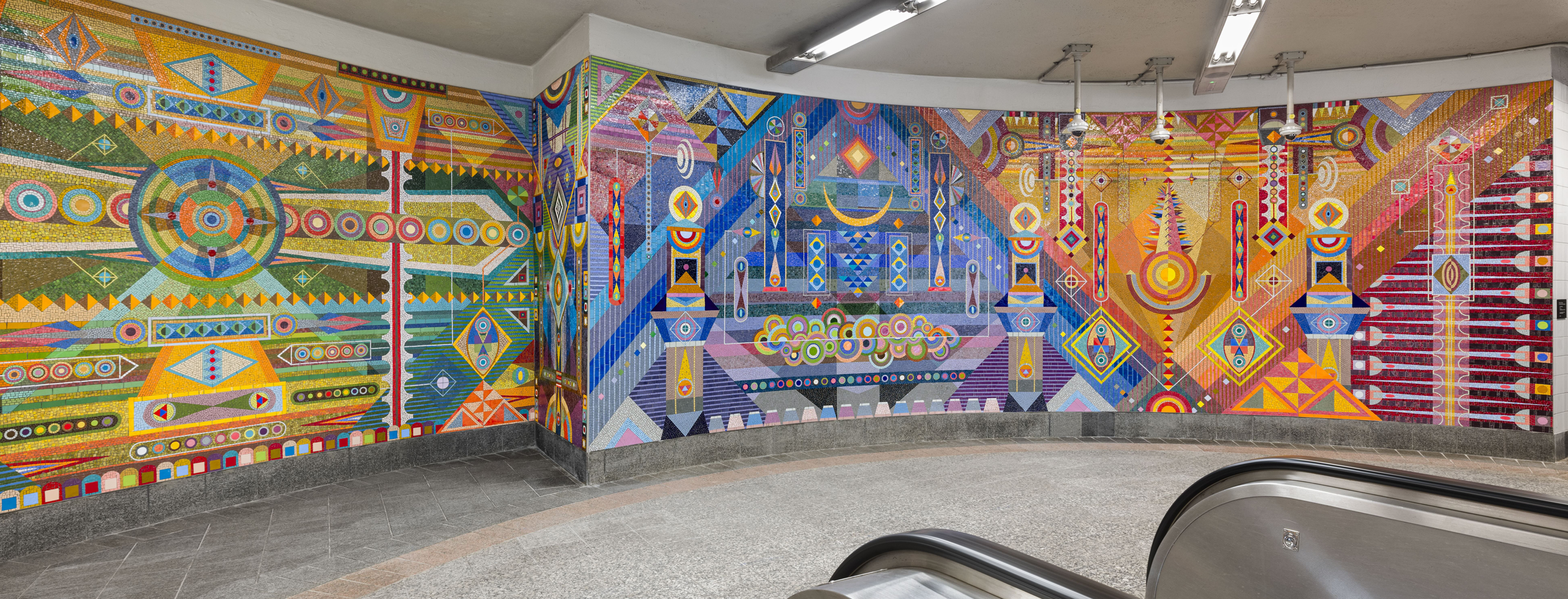
Dannielle Tegeder has completed many high-profile public art projects, including commissions from MTA Arts and Design in Grand Central Station, NYC Percent for Art, and Meta Open Arts (Formerly Facebook Open Arts).
Tegeder recalls being a young art school graduate and feeling intimidated and disheartened when thinking about public art projects: “Because to apply for public art, you obviously need images, and you need a portfolio, sometimes of public art. And if you don’t have that, it becomes a catch-22, right?”
To tackle this problem OR to solve this catch-22, she recommends thinking more experimentally about creating opportunities for yourself so that these experiences bolster your portfolio and open doors to more opportunities. For example, looking around you and considering potential spaces for your work like a vacant storefront, an underpass, or a restaurant or cafe may have empty space that could be turned into a mural or place to showcase your art.
Tegeder’s work with her artist collective Hilma’s Ghost (a partnership between her and fellow artist Sharmistha Ray) has taken many forms, including running a school out of their studio, doing things in cemeteries, in cafes, and all types of public spaces. All this is not to say that you don’t apply for the public art opportunities: you still should. But it helps to open up new avenues for you to create and share your work and to focus on the bigger picture of developing your practice as a whole.
Similarly, connecting to your local politicians or opportunities that involve your cultural community could help you to build a foundation for future projects. “I’m big on going and having coffee with someone…Not with the idea that you’re going to push yourself on them, just with this idea that you’re building your community,” says Tegeder. She suggests starting with a well-researched, well-written email not expecting anything that essentially says: “I’ve noticed what you’ve done and I would love to meet you.
Tips for Applying to Open Calls and/or Sharing Your Work for Consideration
- Get out there.
Says Dillon: “As an artist, do whatever you can to get yourself in front of the potential people that might be selecting you, as well as, responding to open calls. And so, all of those kinds of studio visits, all those opportunities are going to be key to your future progress.” - Have and refine your online presence.
For better or worse, people will look for you online. Do you have a website or an Instagram profile, and does it accurately and best represent you? Dillon notes that “People will be looking to see if what you’re representing in your work is what they’re going to get if they commission you.” - Follow other public artists.
Ruggerio points to other artists as helping you navigate your way: “Follow the ones that you like, maybe even follow the ones that you don’t like, and then, you know, you’ll start to kind of see where are they hearing about calls, who are the curators and administrators that they’re working with, and things like that.” - Start regionally.
Ruggerio underscores the value of looking at your local government or municipality’s public art program, and getting to know those programs/players–especially if you’re in a smaller city or place. She also spoke about how, in terms of how to “get on the radar” of the invitation art opportunities, her team is often getting to know the local players/looking at who is making work that would be a fit locally. - If you’re in a highly competitive city, consider opportunities across the country and internationally.
If you’re starting out in New York, there are a lot of opportunities, and there are a lot of artists. “This means that you might be getting into a pool with 2,000 artists,” says Tegeder. “Look across the country if that’s possible for you, or look where your hometown is, or look in different places, because that might just be a little bit more accessible,” she added. For many public art opportunities, you don’t have to be based in the location seeking a commission. - Read the RFP* and follow the instructions.
An artist responds to an RFP to apply to a specific public art opportunity. Your proposal will incorporate your vision/plan for a specific site, and will likely include mockups, renderings, and details as to how you would execute/fabricate the work should it be selected. Once see an RFP that interests you, be sure to read it thoroughly and fully follow the instructions. If you don’t, you may automatically disqualify yourself from being considered.
*An RFQ is when an artist provides general information detailing their background and expertise, or “qualifications,” to be considered for public art opportunities generally. This includes things like previous work samples, a CV or resume, etc. - If you have questions, ask!
Ruggerio says that if you don’t know what is needed, it’s OK to reach out and ask questions. “I don’t know an arts administrator amongst us who would not be willing to provide clarification or some additional amount of information to help you make a successful entry.” - Pay yourself!
This includes paying yourself for the work that you will be doing (20% is a rough benchmark). For example, for a $100k project budget, it’s generally recommended for approximately $20,000 to go to the artist. Ruggerio advises that if you budgeted to paying yourself less than 10% of the overall project budget, the panel will start to have questions. - Invest in high quality images.
While this can be expensive, images are hugely important in your application materials. Tegeder suggests bartering with friends or people in your community: “I recommend finding your friends who are designers, who are in graduate school, finding people who know how to do this and you’re trading, right? What can you do for them?” - Be prepared to speak to non-arts professionals.
Often, not everyone on the panel will have an arts background (could be architects, school principals, people from the community, etc). For example, if you’re up for a commission in a hospital, nurses, administrators, and maintenance staff may be weighing in. You’ll want your proposal to speak to them as well, as they’ll be living with the work every day. Says Dillon: “Do some research so that you understand where they’re coming from. Read between the lines a little bit as to what they might really be looking for, and what’s going to really make an impact.” Make your proposal clear, easy to understand, and engaging for the community you’ll be working with. - Practice public speaking.
If you are selected as a public art finalist, often you are invited (and compensated!) to present your proposal to the panel in person. This is the case for NYC’s Percent for Art program, among others. In this context, public speaking skills become important. Says Tegeder: “As soon as you open your mouth, your project is going to get either more interesting or a lot less interesting. Taking classes or practicing is really helpful because public speaking is something that falls into artists’ laps when you’re not necessarily trained in a lot of ways for it.” - Consider copyright.
Says Ruggerio: “It is a best practice to not ask the artist to give up their copyright for the artwork. That said, there are a lot of places (particularly high profile corporations, like Gucci, Tegeder offered) where they do ask for the artist to turn over the copyright. If you’re in that kind of situation, I would encourage artists to…do what you can to retain the copyright of your work, whether it’s permanent or temporary.” For example, this could mean allowing the entity that commissioned the work to use images of the work for marketing purposes, but not to create a t-shirt that they sell and make money from.
Resources
- Common Terms in Public Art
- Fabrication Resources from NYC’s Department of Cultural Affairs
- NYC Health+Hospitals Arts in Medicine Programs
- Websites for Art Open Calls:
This article shares insights from “Public Art and Creative Placemaking,” a free online panel discussion NYFA presented in partnership with the Northern Virginia Local Arts Agencies (NVLAA), a collaboration of Alexandria’s Office of the Arts, Arlington Cultural Affairs, and ArtsFairfax.
Interested in 1-on-1 career advice from expert staff and art industry professionals? Check out our NYFA Coaching and Consulting program.
Want to bring NYFA programming to your college, university, or arts organization? Visit our Educational Partnerships page to learn how to customize our existing programs to suit your audience’s needs.